Focussing on rare, forgotten, obscure point and click adventure games, preferably in 3rd person.
- The POP Anthropologyst on Rumble
- The POP Anthropologyst on YouTube
- The POP Anthropologyst on Instagram
Dead Mountaineer’s Hotel

Dead Mountaineer‘s Hotel is a graphic adventure game which was developed by ELECTRONIC PARADISE from Kyiv, Ukraine, and published in 2009. The story of the game is based on a novel by the Strugatsky brothers, who are considered the most influential writers of Soviet science fiction.
The first thing that catches one’s eye when visiting the Steam-page of the game, is, that it has a lot of bad reviews, with only 33% positive. Of course, this has caught my attention. Let us find out whether it is really so bad.
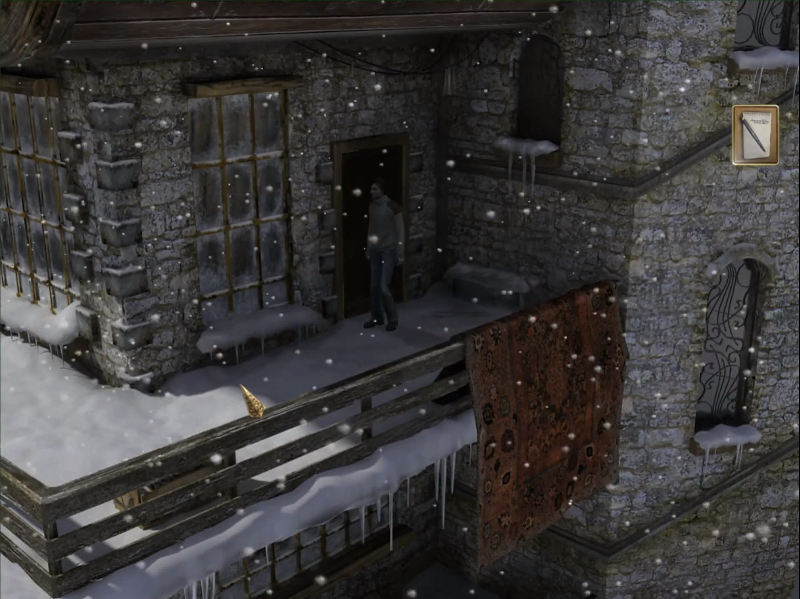
At the first glance the game looks very nice. The intro shows our main character Peter Glebski arriving with his car at a snowy mountain hotel where he is welcomed by the hotel owner Alek. But as soon as the characters start to talk, you will most certainly understand one of the main points of criticism of the reviews: the English voice-overs. They sound like the speakers were not very eager to do the talking and it is actually really hard to bear. So, you either get used to it, turn off the sound, or you stop at this point. Or, as a fourth option, you can switch to Russian or German. In contrary to the English voice-overs, the Russian and German ones are excellent. Suddenly the game has much more appeal, the fun can commence.
We are taking on the role of Peter Glebsky, a middle-aged detective who wants to spend his 2 weeks of holidays at the У Погибшего Альпиниста, the Dead Mountaineer’s Hotel. Only a few guests are staying at the same time at the hotel, and soon after his arrival Peter gets to know most of them. The hotel owner Alek Snevar has a friendly relationship with his customers. Some noteworthy guests are the magician du Barnstoker, his niece Brun, the eccentric rich couple Moses, or our next door neighbour, the physicist Simon Simonet. During our stay at the hotel, strange things start to happen. Boots disappear, and re-appear elsewhere, or towels are suddenly soaked in water. Is this just some stupid joke, or is it the ghost of the Dead Mountaineer? As the story unfolds, we find ourselves in the middle of several investigations, not the holidays we had wished for.
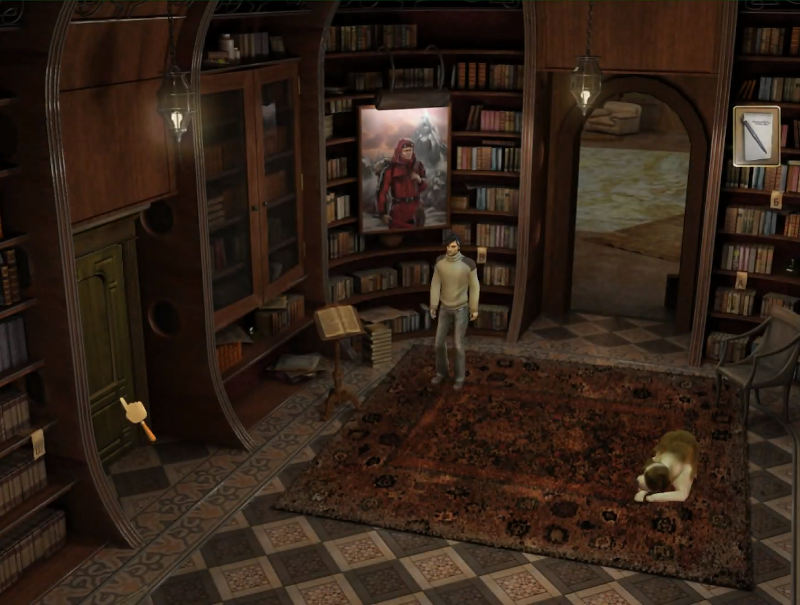
The hotel itself is very nicely designed, it is quite large and it takes some time to discover all the rooms. The Dead Mountaineer’s Hotel reminds in style a lot of the Agatha Christie games by the Adventure Company. To trigger certain events, the player has to converse with the other guests and pick up and use certain items in a classic point and click manner. Dialogues can be skipped with space, right click opens the inventory. There are quite some puzzles and minigames included which the player has to accomplish in order to proceed, like playing billiard, darts or keeping Peter on his skies.
All in all, it is not so bad as they say, the English voice-over is really a killer though, and also the ending arrives too suddenly and is not very logical. Let’s face it: Dead Mountaineer’s Hotel certainly cannot keep up with other titles that came out in 2009, like Sherlock Holmes vs. Jack the Ripper, Still-Life 2, or Memento Mori. However, it was fun while it lasted, I loved to explore the hotel and the atmosphere of the snowbound location.
Elsinore

Elsinore is a narrative-based graphic adventure game by GOLDEN GLITCH which was released in 2019. The Shakespearoes among you are certainly familiar with the title of the game.
Yes, it is the Danish city of Helsingör, known in English as Elsinore. It is where Shakespeare‘s drama The Tragedy of Hamlet is taking place. Elsinore looks like an ordinary p’n’c adventure, but it has its own unique take on the genre.
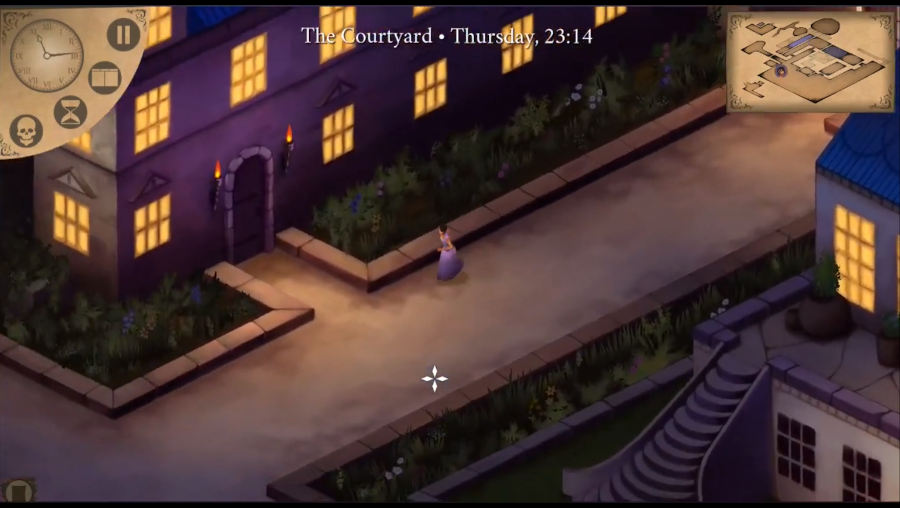
The main protagonist of Elsinore is not prince Hamlet, instead we experience the story through the eyes of Ophelia, a young noble woman who lives at the Danish court. Ophelia finds herself in the middle of a critical time for Denmark. King Hamlet has recently deceased, his brother Claudius has taken his wife and throne. Young Hamlet suspects foul play.
Above all, the court has to deal with enemies within, as well as with threats from outside. The game is taking place solely at the Danish court, has a limited amount of locations and characters. Elsinore is not simply a playthrough of Shakespeare’s drama, which would be good by itself, but it is in fact a time-loop-manager.
Ophelia finds herself stuck in a time-loop, the young woman is experiencing the same four days over and over again. After four days have passed, or when our lady dies, the time-loop resets and the story unfolds again. But Ophelia remembers all the information she has gathered during the past loops, and the more she knows, the more she is able to temper with the events. Will it be possible for her to break out of the time-loop and bring everything to a satisfying ending?
The story unfolds in real time which can be very challenging. To gather information, Ophelia has to be in the right place at the right time, where she can eavesdrop or intervene to find out about or trigger future events, or to prevent certain events from happening. To push the story Ophelia has to confront the different characters with certain facts and rumours, but be careful, not every information is meant to be shared with everyone.
The interface is very well designed, in the top left corner the player has a journal with the collected information about events and characters which auto-updates as the story progresses. The most helpful tool is the timeline, in which we can see what has already happened and what events are likely to happen in the future. There is also the possibility to fast-forward time go get quicker to a certain incident.
In the upper right corner we can access the map of the Danish court to see where something is going on and to fast travel from A to B. The graphics and animations are very well designed, I especially like the avatars of the protagonists.
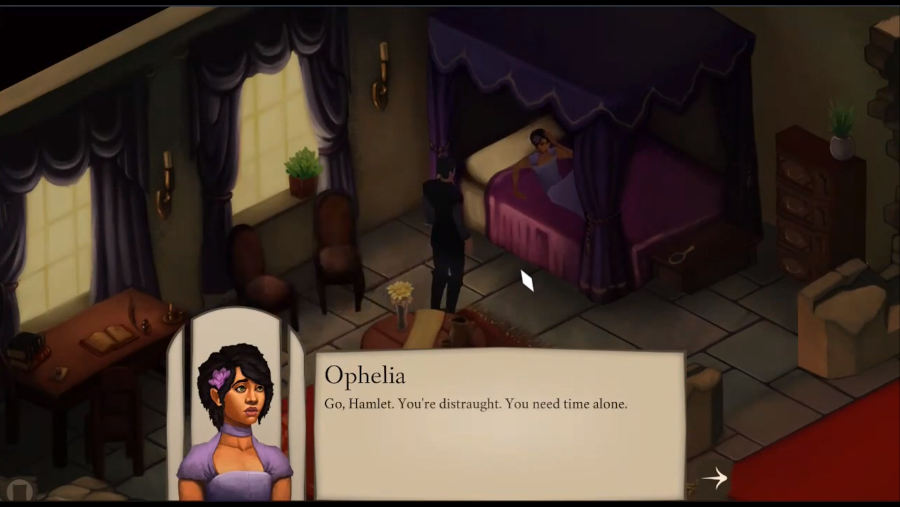
The player has the possibility to switch between traditional and modern clothes for the characters. The voice-acting of the dialogues is interesting, as only some words and interjections are pointed out. There is a lot of reading to do, and one of the few downsides I have found with the game is that there is no possibility to skip already heard dialogues in their entirety which can be tedious at times. But at least you can skip sentences with space or a click.
Elsinore is a great game for Shakespeare-fans, but not only. Even if you are not familiar with the story of prince Hamlet of Denmark at all, it is definitely worth your time.
Overall it is a clever game with a lot of love for details and its very own charm. In the beginning the concept is a bit hard to grasp, there is a short period of time which you have to pull through, until it becomes evident what you are supposed to do. Once you are captured by Elsinore’s magic, it is hard to stop playing. It is like playing chess through time.
Undercover Missions: Operation Kursk

Undercover Missions: Operation Kursk K-141 is a third-person point-and-click espionage thriller developed by The Game Species, and published by Ravenscourt in 2015. The story is inspired by historical events surrounding the sinking of the Russian submarine Kursk in the Barents Sea in the year 2000. Till today it in unclear what really happened – a welcome fodder for conspiracy theorists. Operation Kursk K-141 is therefore not a factional re-narration of the tragic occurrence, instead offering a fictional explanation of the circumstances which lead to the disaster.
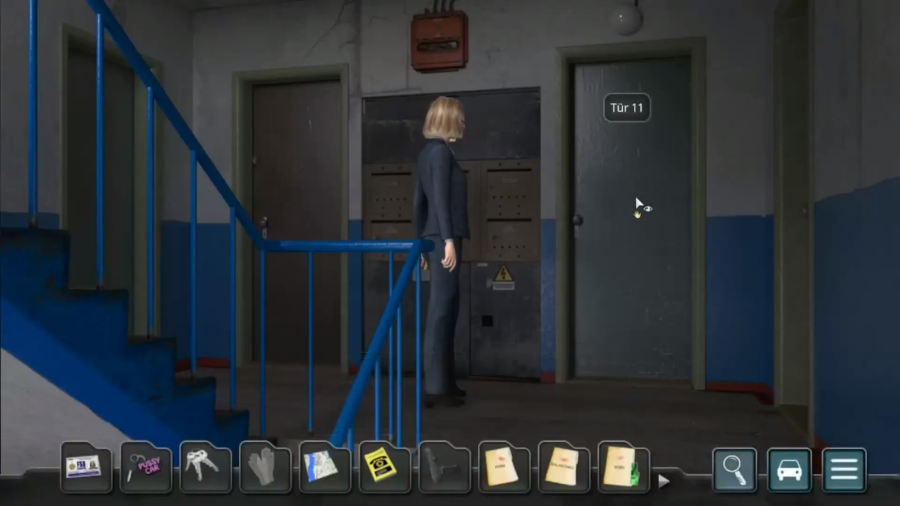
At the first glance the game looks nice, similar in style to adventures that were released in the early 21st century. The game has received mixed reviews on Steam, often criticising the English voice-overs. Honestly, they could have been better but the voice acting is not especially bad, it just lacks a bit of enthusiasm. Steam offers a French language version which is mediocre, and a German one which is quite decent.
The player is taking on the role of Milena Belyaeva, an agent of the Russian secret service. Milena is part of a special unit of the Secret Service FSB, called the URPO, which is fighting against organized crime. During her investigations, Milena follows up on some leads which make her eventually board the Kursk. Undercover our heroine infiltrates the submarine, trying to figure out what is going on. In essence, the story is a flashback leading up to the events of the sinking of the Russian submarine. Except for a few moments, the game is set almost entirely on the submarine.
The left mouse button makes Milena interact with people and objects, the right-click serves as look-at function. Interesting is the use of the double-click in order to use an item. At some occasions the player has to click the same object multiple times to get a result, so make sure to check everything thoroughly.
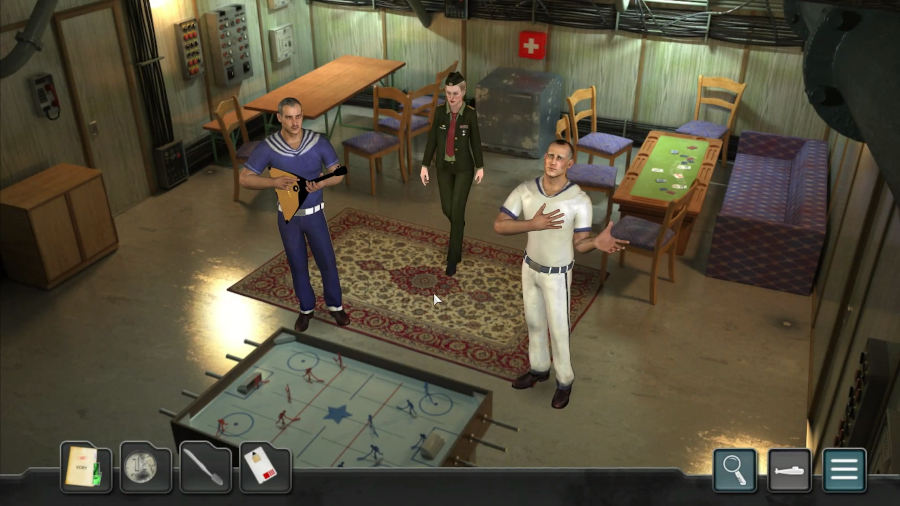
At the bottom the inventory is shown, next to three symbols. The magnifying glass is a very helpful tool, which reveals all hotspots on the active screen. A click on the question mark in the upper right corner shows some hint regarding the current objective.
Through a map the player can fast-travel from one room to another, but not all rooms are accessible at all times which makes sense considering that the Kursk is a military vessel where some locations can only be accessed by higher ranking officers. In order to get there, Milena has to acquire certain keys or access cards. The story is divided into nine chapters.
In a typical point and click adventure game manner the player has to solve several puzzles and minigames which are usually not too difficult.
Operation Kursk is a straightforward game, quite logical and not too difficult. Although it is not the crème de la crème of point and click adventures, it has also its positive sides. I liked the puzzles and the graphics, and I especially enjoyed the setting on the Kursk. The echoey soundtrack – a constant hum – emulates the atmosphere of being on a submarine. If you have ever wondered how it feels to be on a sub, here is your chance.
The Lost Files of Sherlock Holmes: The Case of the Rose Tattoo

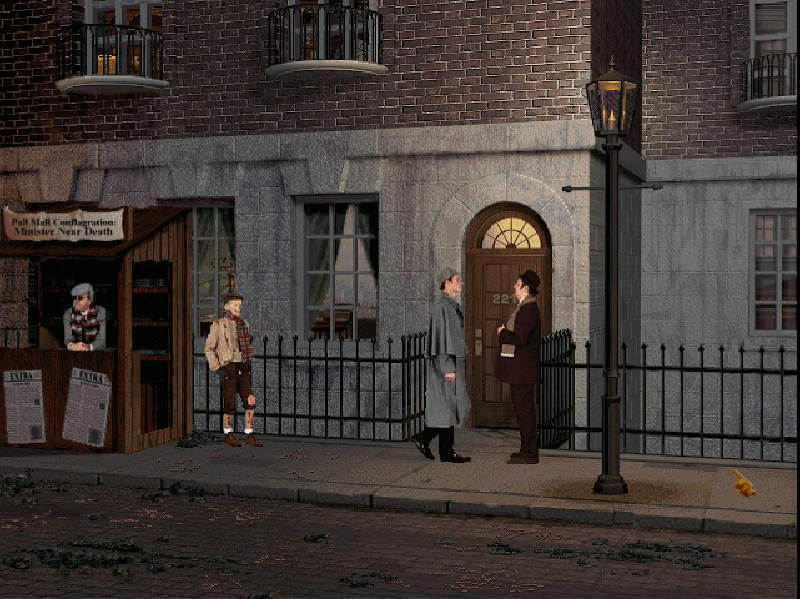
The Lost Files of Sherlock Holmes: The Case of the Rose Tattoo is third person graphic adventure game from 1996, developed by Mythos Software and published by Electronic Arts. It was the second and unfortunately the last Holmes-game in a series, whose first part was the critically acclaimed Case of the Serrated Scalpel from 1992.
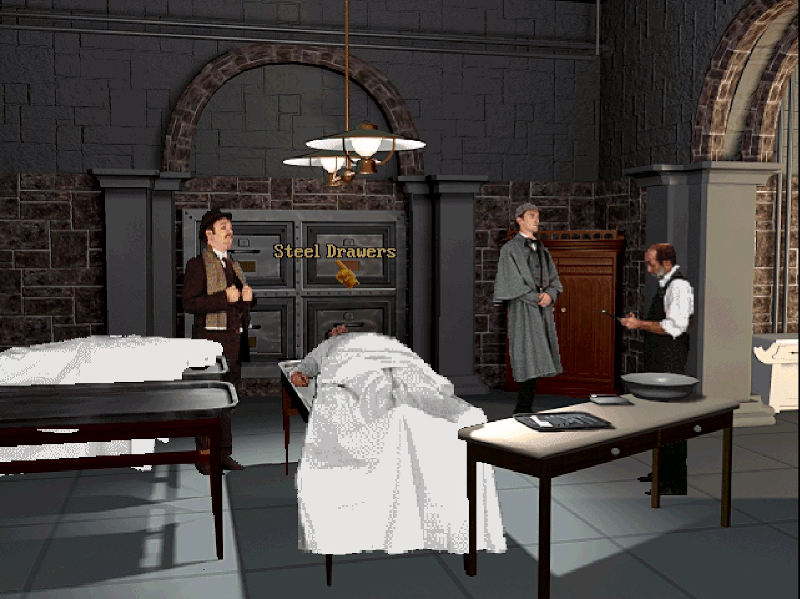
The Rose Tattoo is set in London in 1889. In the beginning of the game, Sherlock receives a message from his brother Mycroft whom he and Dr Watson should meet at the Diogenes Club. When the two are about to enter the club, a strong explosion inside throws them off their heels. Luckily, Holmes and Watson withstand the blow unscathed, in contrary to Mycroft, who has been heavily injured. Sherlock is devastated, locks himself in his room, and refuses to investigate. Allegedly the explosion was caused by a gas-leak but Watson believes otherwise, and starts an investigation on his own. Watson – only after having uncovered some clues – can eventually convince the master detective to lead the investigation, of which the explosion is just the beginning.
The Case of the Rose Tattoo is a very long and complex game. It is mostly non-linear which means the player really has to think like a detective to uncover the countless mysteries of the case. Some loose ends can also turn out to be dead ends. During the investigation more and more places are accessible on the map which you can roam freely.
While in the new Holmes-games by Frogwares, Watson is kind of useless, just standing in your way or scaring you to bits, in The Rose Tattoo dialogues with your partner are essential. John always has some comments about the investigation, offering clues that will lead the player in the right direction. Unlike many other adventure games, The focus of The Rose Tattoo lies much more on dialogues, observing your surroundings and spotting small details than puzzle-solving. During a playthrough you will encounter some minigames, such as analysing and mixing substances on Holmes’ table, or playing a game of darts in the pub.
For its time the game looks exceptionally neat, the characters are played by real actors who were filmed against a bluescreen. What I liked perhaps most of all were the voice-overs. The voices of Holmes and Watson are excellent, and add a lot of surface to the atmosphere of the game. For non-English native speakers it can be sometimes hard to understand, as the language used is quite posh and elaborate which fits to a plot set in the late 19th century.
One of the few downsides I’ve found with this game is the handling of the ínventory and the overall slow pace. But once you got used to that and are caught in the case, this doesn’t matter so much anymore. Also it is very picky about observation in order to gather new information, so be sure to click on every possible hotspot, maybe several times.
The Case of the Rose Tattoo cannot be finished in a few hours, it will take days or maybe weeks to bring it to a satisfying ending (unless you use a walkthrough). It is authentic, tough and captivating. With its pace, difficulty and its non-linearity this game is the perfect antithesis to many contemporary games which focus on cosmetics rather than on a good and solid plot.
The Case of the Rose Tattoo is unfortunately not available on Steam or Good Old Games, so you would have to acquire it from elsewhere. It runs easily on modern systems, as it is compatible with ScummVM.
The second part of the Lost Files of Sherlock Holmes is a gem of the mid-90s and seems to have been a bit forgotten. However, compared to its flaws the game has so much to offer which makes it in my opinion to one of the best adventure games ever written.
Mozart: The Conspirators of Prague

Mozart: The Conspirators of Prague, also called The Last Secret, is a 3rd person point and click adventure game from 2008, developed by Game Consulting Studios and published by Micro Application – both located in France.
You might have never heard of this game, as it was never officially published in English. Luckily there is a patch around with which you can anglicize the French and the Dutch versions. After patching the game you’ll soon realise that the subtitles show some spelling mistakes which you can politely ignore, as the English voice-overs are quite decent. Obviously an English version was planned but never released. The game is not so easily obtained nowadays, your best bets would be perhaps Ebay or Medimops.
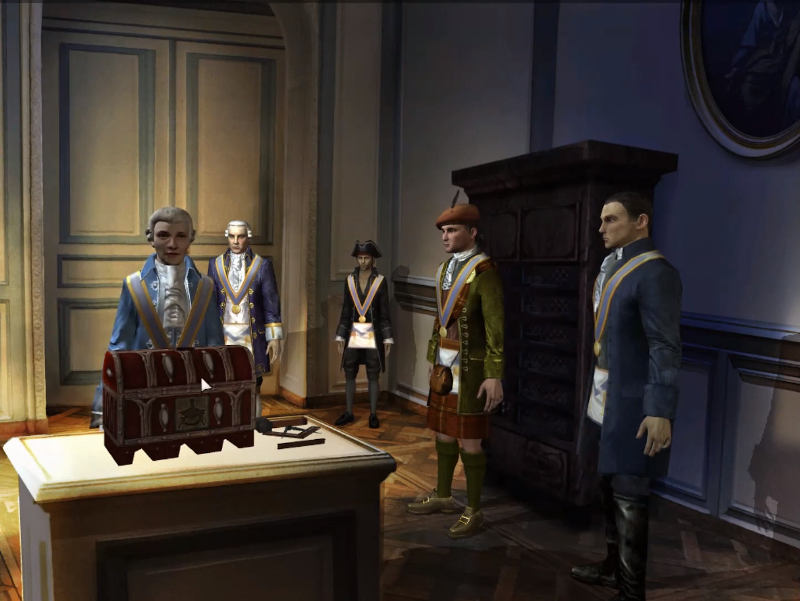
Prague 1788, the peak of the Enlightenment era. The Austrian composer Wolfgang Amadeus Mozart has travelled to the Czech capital city to prepare the debut of his new opera Don Giovanni. After a mysterious dream Mozart rouses in his hotel room where the owner informs him that the Emperor Joseph II, the benefactor and a personal friend of our main character, wishes to see him. Only after pawning a valuable watch by the Prague clockmaker-master Epoch, the moneyless Mozart is allowed to leave the hotel. Before meeting the Kaiser, the young composer drops by the opera to make some last preparations and rehearsals for Don Giovanni. The visit at the palace doesn’t last very long, as the Monarch is ill. Mozart performs a song for him, while Joseph II is listening from his bedroom and waves at the composer, before the doors are closed again. In the evening Mozart, who is a Freemason, is invited to part-take of a gathering at the Prague Lodge. The composer is welcomed by his Masonic brothers but soon after, strange and mysterious things occur, and suddenly our characters finds himself in trouble and in the middle of a knee-deep conspiracy. Can our hero get himself out of this mess and shed light on the mysteries that surround him?
Optically Mozart: The Last Secret is eyecandy and can easily keep up with other titles that came out around the same time, like Mata Hari, Sherlock Holmes: The Awakening, or Chronicles of Mystery. Especially nice are the scenes set in the historical centre of Prague. You will walk on the famous Charles Bridge, or across the square where the famous marvelous astronomical clock, the Orloj is located. If you have ever been to the Czech capital you’ll surely recognise one or the other location. The inventory, a journal and some tools for decrypting messages can be found at the top of the screen. Regardless of the mistakes in the subtitles, the English voice-overs are very good and capture the atmosphere of the late 18th century well, as does the soundtrack which comprises the finest tunes by the master Mozart himself.
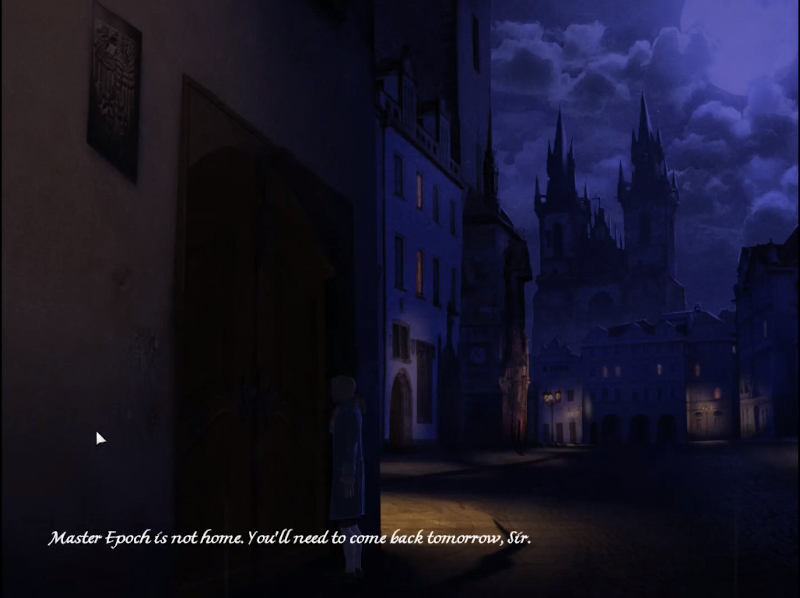
The Mozart game is not very easy, due to its countless well-made puzzles and mini-games which demand skill, logic and patience. A good hearing and a basic knowledge in music theory are recommended, if not necessary, as the player has to solve several music related riddles and puzzles, such as correcting music scores. Once the scores are corrected they are used to crack coded messages by the secret societies of the Freemasons and Rosicrucians. Non-music related mini-games include a game of 31, or some that are dealing with mechanics. The only downsides of this game that I have found are that it is not always easy to find the right spot to change a room and that some hotspots don’t react as they should. But these are minor issues.
The story of The Last Secret is intriguing, it is mostly fictional embedded in a historical setting – it has even some steampunk elements. Just to set one thing right because as an Austrian one mistake from the game’s description is bothering me: Joseph II, son of Maria Therese important reformer, was not the Emperor of Austria-Hungary, but of the Holy Roman Empire. The story of the game is set in 1788, there was no Austria-Hungary yet, as it came into existence only 79 years later in 1867.
That said, I can strongly recommend The Last Secret, The Conspirators of Prague or Le Dernier Secret, however you want to call it, this one is really an obscure treasure for adventure gamers, conspiracy theorists, Mozart fans or music enthusiasts.
Murder in Tehran’s Alleys

Murder in Tehran’s Alleys 1933, Devil in the Capital, and Murder in Tehran’s Alleys 2016 form a trilogy of detective noir adventure games developed by RSK Entertainment and published on Steam by Strategy First in 2017. These games can be played independently of each other but I recommend playing all three, in order to get the whole experience.
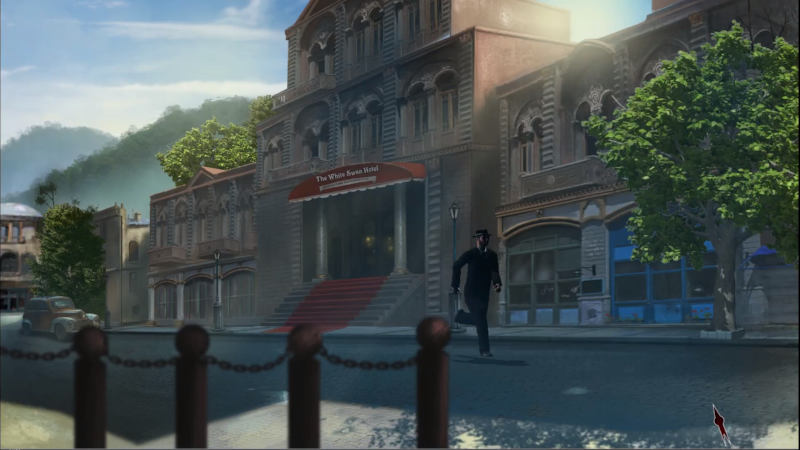
Let’s call it the Iran-detective-trilogy, as all three games take place in said country, mostly in the capital city Tehran, except for Devil in the Capital which is set in the coastal city of Rasht. With this trilogy we experience three police investigations in three different decades.
The games are not dubbed in English, all character speak in their native language Farsi, or Persian, the main language of Iran. English subtitles are of course available. Unfortunately, the translations are not very good. Given the exotic setting which Iran is for most of us, being forced to play the game in a different language adds to the atmosphere, as does the soundtrack which has some Persian feel to it.
Let us now have a closer look at each of the games:
Murder in Tehran’s Alleys 1933 is the first of the trilogy. A series of brutal child murders erupts the city of Tehran in the year 1933. Detective Mohammed Afshar is assigned to the case, and starts to investigate. Soon he finds some leads to follow which will make him uncover some terrible truths.
The second one, Devil in the Capital, is taking place in the early 50s. Mohammed Afshar finds himself in the city of Rasht to investigate a murder mystery. When settling into his hotel room, another murder happens right in front of his accommodation. The victim’s heart was removed. What is going on? While investigating, Afshar gets caught in a web of political intrigue.
Murder in Tehran’s Alleys 2016 is the last of the series. Our main character here is detective Faramarz Afshar, I guess it is Mohammed Afshar’s grandson. This time the case is about a crystal meth addict who kills his whole family while being under the influence of the substance. After realising what he has done, he begins to take revenge on those who made him a junkie.
All three cases offer a solid detective mystery, but beware, they can get quite gory at times and are therefore not for the faint of heart. The Iran-detective-trilogy is not very difficult to play but difficult enough to be enjoyable. The detective himself mostly will give you some clues. If not, each of the detectives has a very helpful journal with him. The inventory is located on the top, space reveals all hotspots on the current screen.
For the fact that it is an independent game, the graphics are very nice, especially the backgrounds. It is great to discover a more unusual location in adventure games. Cutscenes are made in comic style. The looks of the main character were most likely changed, as Mohammed Afshar looks older in the cutscenes and has a mustache.
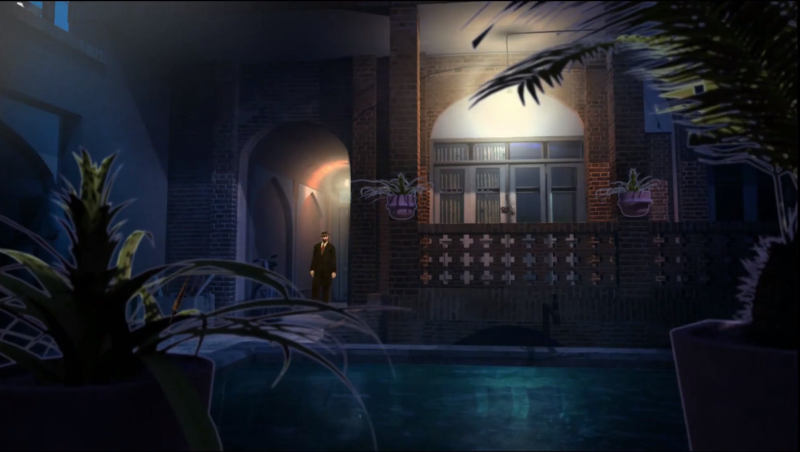
The player has the chance to get some insight in daily life, cultural norms, and social interaction in Iran. Most striking and sometimes irritating was for me the exuberant amount of politeness the detective displays.
In all three games of the Iran-detective-trilogy we can find countless minigames, such as the usual torn letter puzzle or a game of sudoku.
All three games have received some bad reviews on Steam, stating the quality of the English subtitles, while others were irritated by listening to a language other than English. Indeed, it is a pity when a game fails through a badly made translation. However, the Tehran-games are far from being bad, they are solid noir murder mysteries, and I quite enjoyed diving into a world which is so different from mine. If you are able to look beyond some glitches, these games are definitely worth playing.
If on a Winter’s Night Four Travellers

If on a Winter’s Night Four Travellers is a narrative-driven point and click adventure by Dead Idle Games, published on itch.io on the 10th of March 2021. This brand-new game is essentially the work of two people, Laura Hunt and Thomas Möhring.
At first glance you can already see that this is a project of passion. Pixel graphics in the vein of Gemini Rue or Metaphobia, but with a lot more love for detail, with an atmosphere similar to The Last Door or The Charnel House Trilogy. If on a Winters Night Four Travellers was created with Adventure Games Studio, one of the most used engines for making indie adventures.
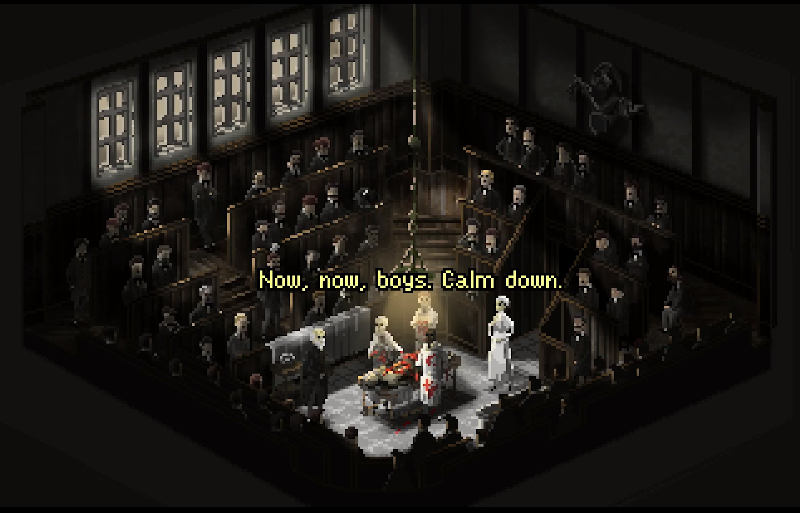
The title of the game is inspired by a novel by Italian writer Italo Calvino, but as I haven’t read it, I can’t tell whether the plot is also influenced by it.
The story of the game is set in the late 1920s. At a masked ball on a train four travellers meet. Three of them don’t know how they got there. Being asked by the fourth, each of the passengers tells their story, the last things they can remember.
And now the game commences. The player plays through each of the three stories. I am trying to be as vague as possible, in case you haven’t experienced the game yet.
The first tale is called ‘The Silent Room’. We are taking on the role of Carlo, who is waiting for his paramour Patrick in a hotel room in Rome. This meeting doesn’t go as planned, trouble lies ahead…
The second chapter ‘The Vanishing of Lady Winterbourne’ is the sad story of a rich woman who escapes from a traumatic experience into a world of drugs where she is haunted by her past.
The third passenger is Jordan Samuels, a young doctor, who is constantly belittled and ridiculed by his colleagues. To get back at his harassers, Jordan intents to carry out a dangerous occult ritual.
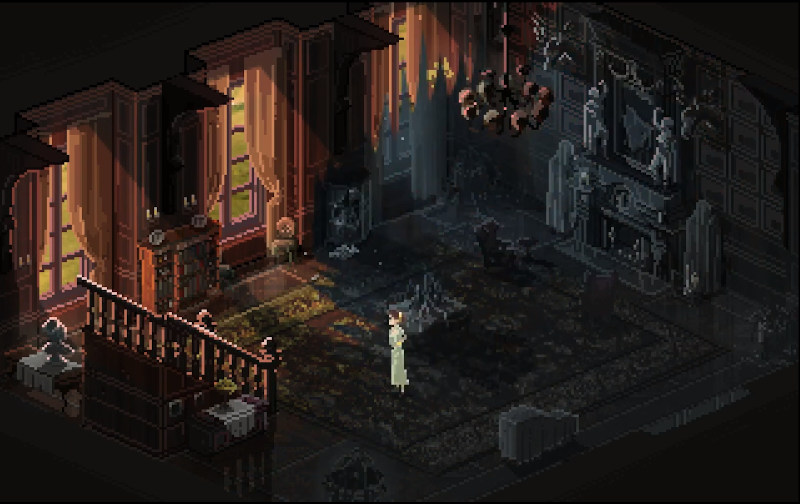
The last story is the one of the fourth passenger, and definitely a surprise.
If on a Winters Night is about the narratives which touch social topics of the time it is set in, and about the atmosphere which reaches from sad over creepy to horrific, underlined by an appropriate soundtrack consisting mostly of classical music. Unlike many other point and click adventures, the player has no inventory at hand, items are used one after another. The puzzles are usually not too difficult, but are an apt means to push the story further.
If on a Winters Night Four Traveller is not too long, a playthrough lasts about an hour if you rush through, but if you are a traditional adventurer who loves to immerse oneself in a game, likes to explore everything, it should take you no less than three hours. Oh, and I almost forgot, the game is available for free!
Thank you very much, Laura and Thomas, for your amazing effort, for you immersing stories and the lovely pixel graphics! Hope to see more of your work in the future!
Chronicle of Innsmouth: Mountains of Madness

Chronicle of Innsmouth: Mountains of Madness is a third person point and click adventure game, which was developed by Italian studio PsychoDev and released on the 23rd of March 2021, after a sucessfully funded Kickstarter campain. It is already the second game by the team around Umberto Parisi, the initiator of the Innsmouth-series, but worry not, the two games can be played independently of each other, or you can play Mountains of Madness first, as its plot is set ten years before the first instalment.
The story of Mountains of Madness is inspired by the 1931-novella of the same name by American horror author H.P. Lovecraft but the game adds a lot of additional content to the story, hence, even to those familiar with the tale it has one or the other surprise in store.
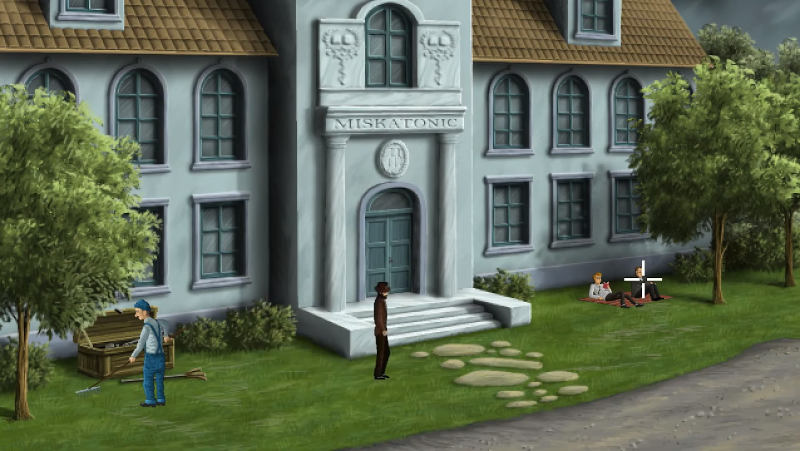
Mountains of Madness is set in 1919. The intro shows an Antartic expedition. A group of researchers has found the remnants of an ancient civilization. After that the plot switches to the main protagonist, the private investigator Lone Carter. Without much of an introduction, Carter is regaining consciousness on a beach outside a cave near the town of Innsmouth, Massachusetts. He is terribly mutilated and in the last moments before his death, Carter recalls the horrible events which have led to this situation. Surprisingly, Carter does not pass away but comes back to life, completely unscathed. His limbs have mysteriously grown back. Without hesitation Cater manages to escape the dreadful and spooky town and returns to his hometown Arkham. Carter is a cool and relaxed character who immediately resumes his work. When the private detective is getting involved in the investigation of a ritual murder, the story unfolds and our main protagonist reveals step by step a great enigma. Gladly Carter is not alone: During his quest he encounters two people that will help him uncover his own mystery. Between, the player takes also on the roles of Abdul Alhazred, the author of the Necronomicon, or H.P. Lovecraft himself.
In contrary to its predecessor, Mountains of Madness features complete English voice-overs which are excellent, I especially liked the voices of Lone Carter and occultist William Blanko. The soundtrack is extraordinary and enhances the atmosphere of the game richly.
Mountains of Madness was created with Adventure Game Studio and has a lovely nostalgic feel to it. The wonderful pixel art conveys the splendour of the 90s classics. The inventory can be found on top of the screen, the controls are leftclick for interaction and rightclick for examination, as we know it from games like Broken Sword. Mountains of Madness is not an easy game, neither in story nor in difficulty. Some puzzles and riddles can get quite tricky. As an experienced adventure gamer, I have found out that the best games are those where you have pen and paper ready to assist you with the solving of some puzzles.
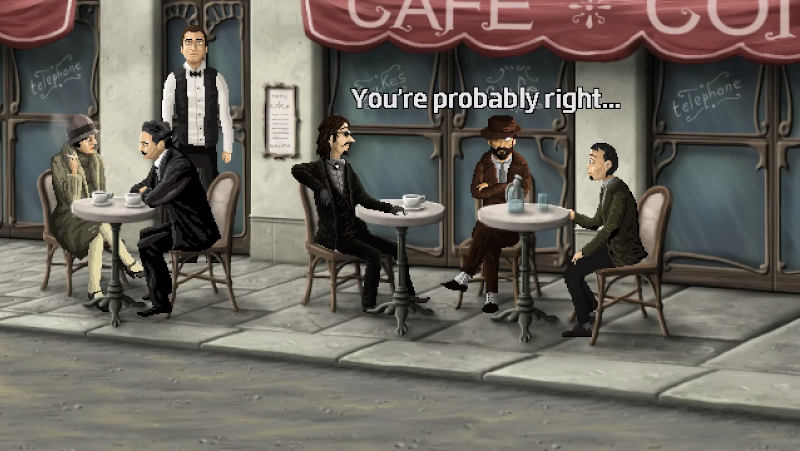
You will encounter also several minigames in Mountains of Madness, during your jouney you have to e.g. pick a lock, mix an antitode, or open a safe. There’s also one timed event where you have to elude the inhabitants of Innsmouth. Jumpscares are rare, as the Lovecraftian horror is much more on the psychological side.
All in all, the second instalment of the Chronicle of Innsmouth series is an intrguing game which manages to keep the player hooked and excited. Compared to its predecessor, which I also enjoyed very much, Mountains of Madness is a huge improvement in storytelling, art, atmosphere, and conceptualisation. I think it is my favourite Lovecraftian game now, next to Prisoner of Ice. I am quite certain it will find its righteous place among the classics.
Undercover: Operation Wintersun

Undercover: Operation Wintersun, or Operation Wintersonne in the German original, is a third person point and click spy-thriller adventure from 2006, developed by the Austrian company Sproing Interactive and published by ANACONDA. A spin-off of the game by the title Undercover: Dual Motives was published for the Nintendo DS in 2007.
The story of Operation Wintersun is set in the middle of World War II. The player is taking on the role of Dr. John Russell, a renowned nuclear physicist, who is approached by the MI-6. The British Secret Service has gained evidence that the Germans are about to finish the world’s first nuclear bomb. Dr. Russell, who is an expert in the field and fluent in German, is sent to Berlin, to stop the Nazis from finishing the bomb. Now, Dr. Russell is a genius, but he is no James Bond. That’s why he is accompanied by a real spy, Peter Graham. Arrived in Germany capital city, the two Brits meet their German whistle-blower and are soon after joined by Grahams colleague, the charismatic, yet rebellious Anne Taylor. His adventure will lead the physicist from England over Germany to Russia. Will Dr. Russell manage to prevent the Germans from building the bomb?
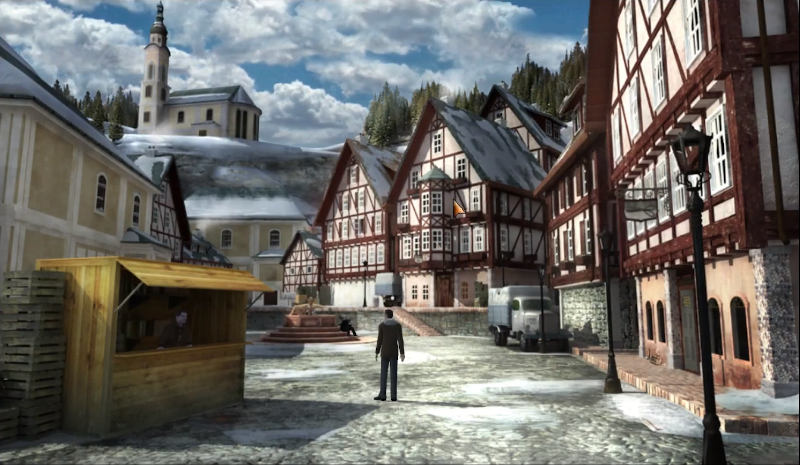
Operation Wintersun looks like a classical 2.5D adventure game, as they were typical for the early 21st century. The handdrawn backgrounds look gorgeous, also the character animations are quite well-made. The left mouse button is for looking at objects, the rightclick is for interaction. You can switch the two functions in the setting to fit your preferences. The inventory can be found at the bottom of the screen.
The English voiceovers are okay, the German ones excellent.
Operation Wintersun is well-balanced in its difficulty, not too hard, not too easy. You cannot die in the classical sense, when you fail you can retry as often as you want to. The puzzles are mostly logical. The game offers a lot of minigames, a lot of them you have to solve in order to open doors.
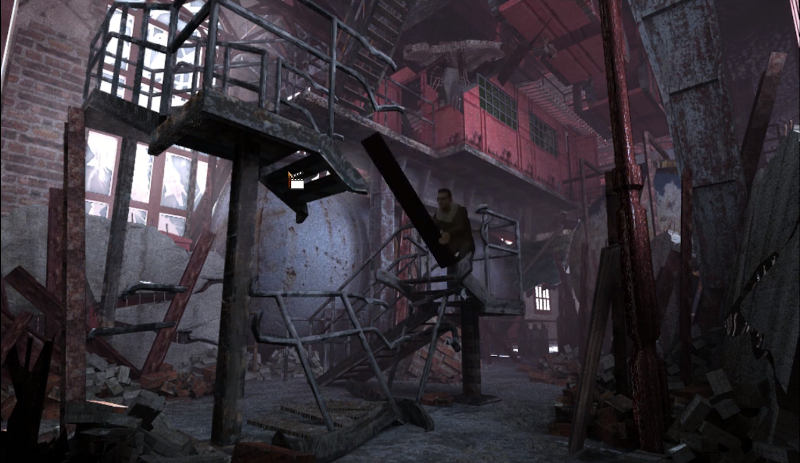
Interesting is definitely the main character of Operation Wintersun. Dr. John Russell is certainly not your usual adventure game character. As a nuclear physicist, he is used to working with his brain rather than with his hands. He is eccentric, stern, a bit clumsy, yet likeable.
All in all, Operation Wintersun is an enjoyable point and click adventure game. The story and the main protagonist are unusual. Unfortunately it is not very long, it can be finished in 4 to 5 hours. Operation Wintersun is neither available on Steam, nor on GOG. You would have to get it from elsewhere, search for it in some second hand stores, perhaps you are lucky.
Hotel

Hotel is a classic 3rd person point and click adventure which was developed by the Croatian studio Cateia Games and published by dtp entertainment in 2010. A remake for iOS and Adroid was released some years ago under the title Brightstone Mysteries: Paranormal Hotel. Nowadays the game is available on BigFishGames. Cateia Games is known for making hidden object games, but with games like The Legend of Crystal Valley from 2009 and Hotel they also had a go in the 3rd person point and click sphere.
Bridget Brightstone was an aspring trainee at the FBI academy. Despite that fact, she decides against the FBI, and starts working for the New York Police Department instead, where she soon becomes a respected member of the force. In the middle of her beach holidays, Bridget receives a phone call from her chief inspector Sam McCloud who asks her to interrupt her trip to look into a mysterious case in France.
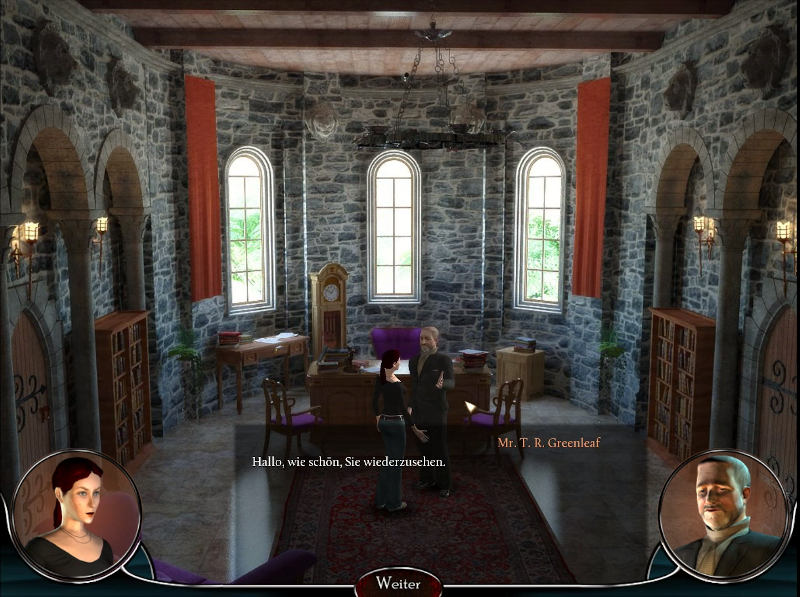
Understandably, Bridget is not very happy about that but eventually does as her boss says. The detective finds herself in the remote castle hotel Bellevue in France, which is led by Sam’s friend Mr. Greenleaf and his eccentric wife. Bridget is already expected by Greenleaf who asks her for help in resolving some mysterious incidents which have occurred at his hotel. A precious necklace has been stolen and the lady who owns it lies in a coma ever since. What looks like an ordinary theft soon turns out to be part of a greater plan. Soon Bridget finds herself in the middle of a mysterious and occult plot. Will she be able to solve the riddle of Castle Bellevue?
The English version of Hotel doesn’t feature any voiceovers, while the German version which I have purchased on DVD is fully voiced during the dialogues. The German voiceovers are actually quite good. What I maybe like most about Hotel is its soundtrack. Somewhere between dark ambient and classical music, it perfectly underlines the sombre atmosphere of the Castle Bellevue.
The background graphics of Hotel are beautiful, the character models might look a bit outdated for 2010 though, but considering it is an independent title they are still not that bad. The inventory can be found at the bottom of the screen, as well as other features like Help, Hotspot Highlighting, Hints, and the Menu. The game features a tutorial for adventure newbies. In case you can do more with an object than looking at it, a verb coin with several options pops up.
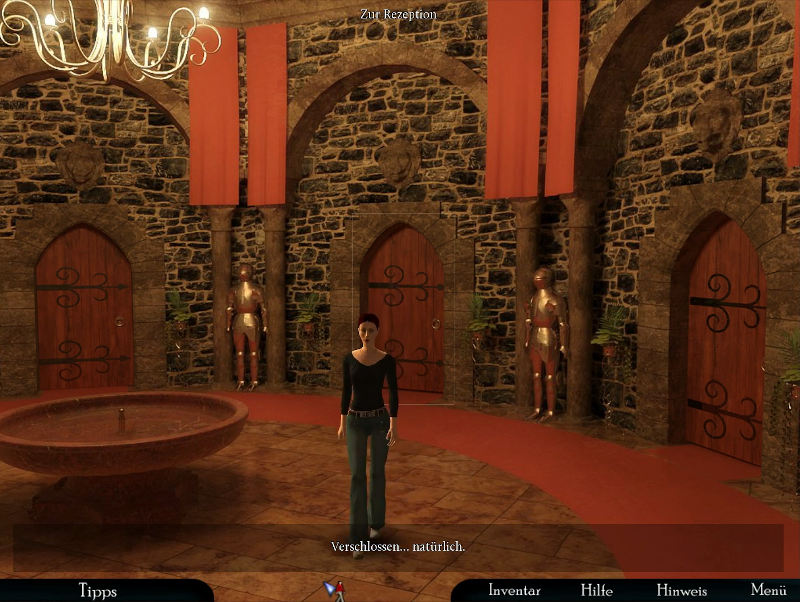
If you like minigames as much as I do, Hotel could be definitely something for you. For its relatively short length, the games features a lot of those. Some puzzles are also time based.
All in all, Hotel is a nice adventure game. It is not very long though, and also not too challenging which makes it rather suitable for adventure game beginners. A downside which is often pointed out by reviewers is that the story is incoherent at times and lacks depth which is unfortunately true. With a little bit more effort, Hotel could have turned out a masterpiece. However, I enjoyed the mechanics, the graphics, the soundtrack, and the overall atmosphere of the castle hotel Bel
levue.
A Stroke of Fate
httpv://www.youtube.com/watch?v=s2ke–gojJ0
A Stroke of Fate is a third-person point and click adventure game, developed by the Russian studio SPLine and published by Akella in 2009. It comes in two seperate games which together consist of three parts: Operation Valkyrie, Operation Adlerhorst, and Operation Bunker. The games are available on Steam where they have received mixed reviews.
A Stroke of Fate: Operation Valkyrie is set in Germany in July 1944, at the peak of World War II. SS-Standartenführer Gerhard Detlef Mayer, a high-ranking official of the Gestapo, is getting more and more disillusioned by Adolf Hitler’s regime. The Soviets are approaching Berlin, the defeat of Germany is inevitable. Yet, Hitler wants to continue fighting till the bitter end, even if that meant the complete devastation of Germany. After having witnessed what is going on in the concentration camps, one thing becomes clear for Mayer: Hitler has to die.
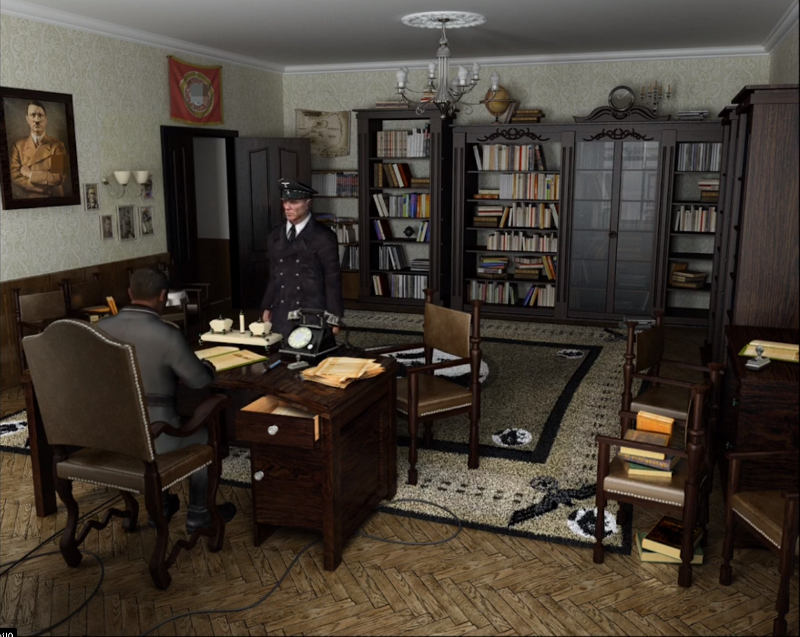
After several failed attempts to assassinate the Führer, the Gestapo is determined to find and punish the traitors. Mayer is assigned a case to uncover a circle of conspirators against the regime. Instead, Mayer joins the resistance, using his position to put the Gestapo off the scent.
After the failed Operation Valkyrie from July 20th 1944, Hitler seeks refuge in his headquarter Castle Adlerhorst. In the second part of the first game, Mayer sees another opportunity for an assassination in the South of Germany.
The second game, Operation Bunker, which came out a bit later, takes place in Berlin in April 1945, in the very end of World War II. Gerhard Mayer continues with his venture to kill Hitler in the Führerbunker.
The Stroke of Fate games are 2.5D adventures with gorgeous background graphics. I especially liked the love for details of the historical setting, many of the characters you meet during your adventure are based on real people. In the options, the player can choose to play the game in colour, in black and white or in sepia. The inventory can be found on top of the screen, the mouse mechanics are left click for interaction and right click for look at.
Most of the negative reviews of both games often mention the quality of the English voice-overs. I really cannot share that view, Mayer may speak in a monotoeous voice, but that’s exactly what I would expect from a guy who works for the Gestapo. There are some side characters with annoying voices but overall I cannot recall anything awful. I guess the release of the second game Operation Bunker was rushed, as it doesn’t feature English voice-overs at all, only Russian ones which are well-made. Subtitles are available in English.
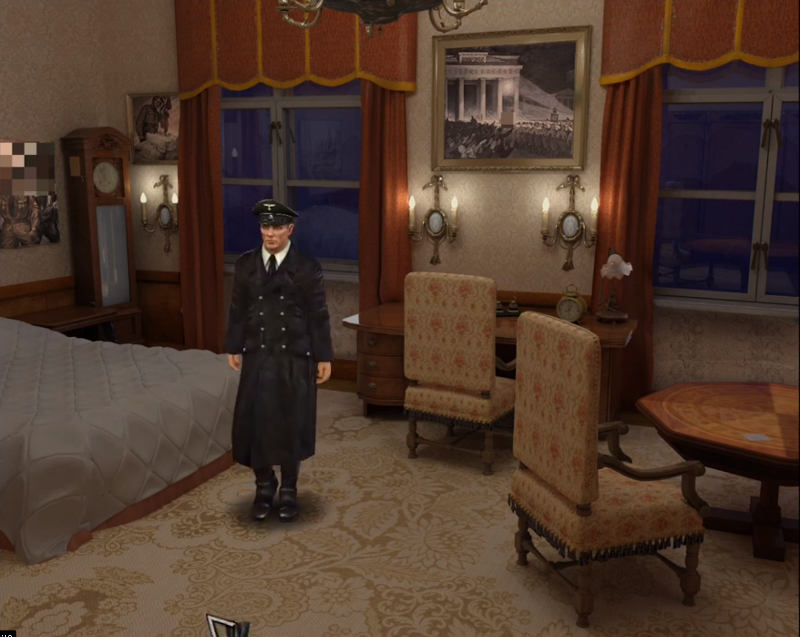
The main character moves very slowly, there is unfortunately no running option. Gladly, with a double click you can switch rooms immediately, and in the bottom right corner you can access a map for fast-travelling which comes in quite handy, as Mayer has to visit his house several times to switch between his uniform and civilian clothes. The Gestapo man also carries a diary with helpful hints for what to do next, in case you get stuck. The overall difficulty is intermediate, most of the puzzles are logical.
During a playthrough of A Stroke of Fate you will encounter several minigames, like decrypting a message, playing a round of poker, or eluding searchlights.
All in all, A Stroke of Fate is a real bleak game. The developers have put an emphasis on authenticity rather than on action or drama. Despite all its flaws, A Stroke of Fate is an ambitious project which perfectly manages to capture the atmosphere of the beginning of the end of the Third Reich.